Data in Society at UCLA: Keeping What Matters in the Light
April 15, 2026
Artificial intelligence and emergent technologies are reshaping how information is produced, circulated and used, challenging institutions of higher learning to respond quickly and critically. The illumination of these societal effects is at the heart of UCLA’s motto, Fiat Lux—let there be light. At UCLA, these issues are both the impetus and focus for a new curriculum that reflects UCLA’s commitment to inclusive learning and works toward preparing students for careers that contribute to the public good: Data in Society (DIS).
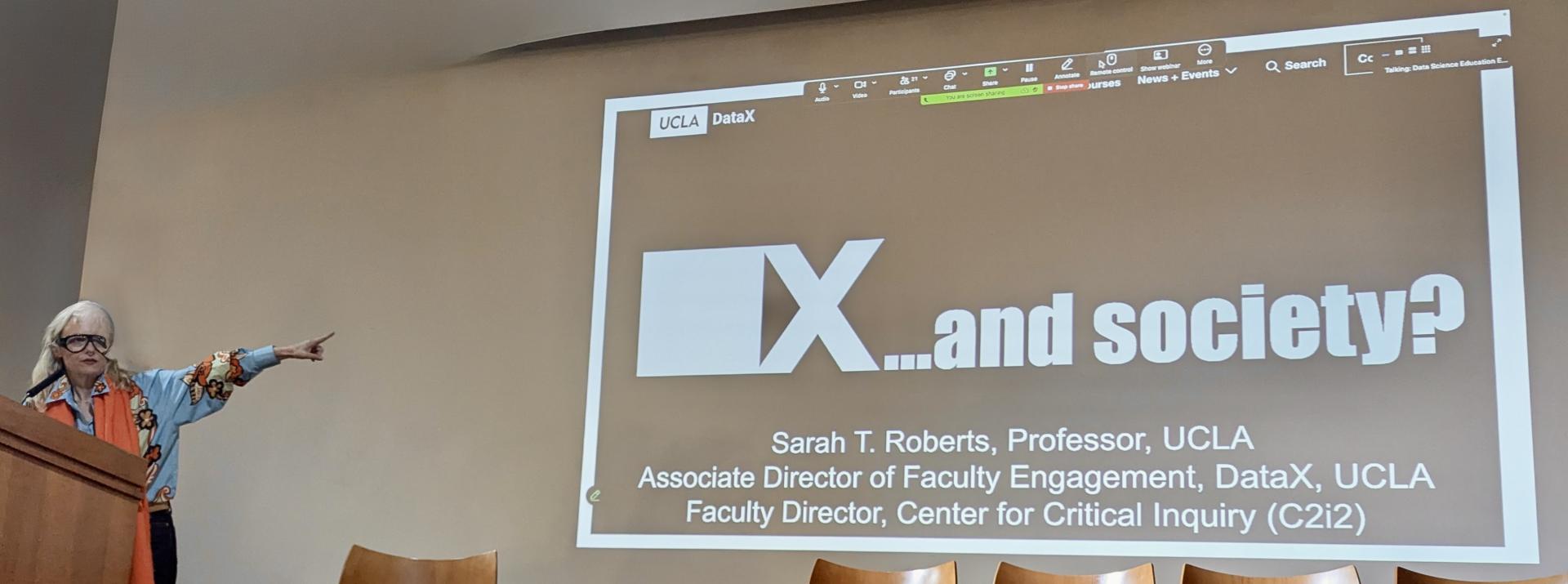
Developed by a group of interdisciplinary faculty across DataX, Digital Humanities and the Division of Social Sciences, DIS offers courses and research opportunities that examine the power and influence of digital technologies on society. Dr. Sarah T. Roberts, Professor and Director of Faculty Engagement for DataX at UCLA believes that every student can benefit from this curriculum, “these courses place students in a powerful position to become much more than simple consumers of the digital and datafied world ... we see UCLA students as the future stewards, policy setters, builders and informed citizen-users of these technologies.”
According to a recent research report on public interest technology authored by Dr. Safiya Noble, Professor and Faculty Director of Data Justice and Critical Data Studies for DataX and Jess Peake, Director of UCLA Law’s International and Comparative Law Program, there is a growing global gap between the expansion of data-driven systems and the workforce prepared to govern them. The DIS course stream engages students in real-world problems, enables them to collaborate across expertise, and empowers them to apply data-driven methods in service of the public good, connecting course work directly to career pathways.
A Foundation for the Future
Two foundational undergraduate courses are offered for the first time this Spring, Theories of the Information Society taught by Dr. Morten Bay, research fellow at the Center for the Digital Future and lecturer, and Critical Histories of Computing and the Internet taught by Dr. Stacy E. Wood, Director of Research and Programs for the UCLA Center for Critical Internet Inquiry.
Both classes filled quickly, signaling high student interest and demand. According to Dr. Wood, “Students are eager for this material. They are used to a narrow vision of technology being framed as something inevitable, and in this course, they get to think about how we got to this moment, placing the technologies we take for granted into historical context in order to see how our current formation of power came to be. Every student has a different way in–they come from engineering, psychology, design–and each brings their own perspective and expertise to the course material.”
These courses build on the established work of the General Education cluster Data, Justice and Society. Delivered by a collaborative team of instructors and graduate student researchers, this cluster provides first-year UCLA students a yearlong, interdisciplinary learning community that foregrounds questions of how data intersects with justice, equity, power and freedom.
Higher education institutions are making significant investments at a rapid pace in data science and artificial intelligence, often incorporating ethics and policy only as a secondary concern. At UCLA, DIS begins with the premise that questions of power, inequality, and governance are essential to building, understanding, and thriving with systems.
From Understanding to Action
UCLA is uniquely poised to meet the growing challenges that emerging technologies pose to democratic systems, including the concentration of power, wealth, and influence in digital platforms and data-driven institutions.
As one of the world’s leading public research universities, UCLA brings together a critical mass of exceptional faculty whose expertise is essential for understanding how artificial intelligence, automation, surveillance, and algorithmic governance are reshaping civic life. These faculty represent a variety of disciplines on campus, including law, public policy, social sciences, engineering, data science, information studies, and the humanities.
This breadth of scholarship makes UCLA an intellectual hub where critical research, interdisciplinary teaching, and public engagement can generate solutions that protect democratic accountability, advance equity, and strengthen public institutions. Equally important, UCLA’s mission as a public university commits it to serving the people of California by preparing students, informing policymakers, and producing knowledge that helps communities navigate technological change in ways that expand opportunity rather than deepen inequality.
At UCLA, Fiat Lux endures as a commitment to shining the light on what cannot be reduced to data: human experience, ethical judgment, care, and the responsibility to act.