OARC: Where UCLA Advanced Research Gets Its Backbone
March 19, 2026
Behind many of UCLA’s most complex and ambitious research projects is a powerful and often unseen resource: the Office of Advanced Research Computing (OARC). OARC provides the shared computing infrastructure, software engineering, and computational expertise that enable scholars to translate large-scale data into discovery.
It’s often a resource researchers don’t realize they need…until their project suddenly outgrows the limits of their laptop, a departmental server, or the tools available within a single lab.
From modeling biological systems or analyzing massive social datasets to experimenting with AI-enabled creative practice or creating new technological inventions, today’s research questions and innovations increasingly require vast computational power, secure data environments, and expert technical guidance that would be out of reach to individual labs, PIs, or research teams.
Three Scenarios, UCLA’s Solution
Scenario 1: Your research project seems to have overnight outgrown your laptop.
Your dataset is too large. Your models take days to run. You’re ready to scale, but the systems around you are not. You suddenly need GPUs, secure storage, and reliable performance. Your work spans disciplines, and you don’t have a dedicated computing team. Without the needed infrastructure, your progress becomes like a spinning wheel of death—just as the research questions need next-level scaling.
Enter Hoffman2
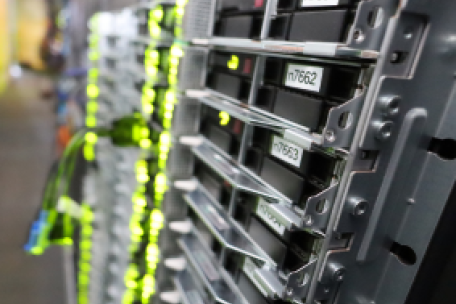
For many researchers, the moment comes when a project can no longer run on a laptop or departmental server. That moment often leads to Hoffman2, UCLA’s high-performance computing (HPC) cluster. The Hoffman2 is a network of powerful computers linked together as a single system that can perform complex calculations, large-scale simulations, analyze massive datasets, train complex models, and perform other computational tasks beyond the capabilities of a desktop.
Individually, these moments look like technical problems. Collectively, they point to something more fundamental: the need for shared campus research infrastructure that allows collaboration to flourish and discovery to advance.
The Hoffman2 cluster was developed to respond to a common problem on research campuses: individual labs purchasing small clusters of machines and running them under desks or in offices, creating inefficient and difficult-to-maintain computing environments. A shared and expert-supported campus cluster offered a more powerful and sustainable alternative.
Its effectiveness is evident. In the last fiscal year, Hoffman2 has supported $272 million in research funding, delivered 110 million compute hours, and contributed to 114 publications. More than 300 research groups and over 1,100 active users rely on Hoffman2 in a typical quarter.
Hoffman2 has also lowered the barriers to participating in computational research. By centralizing advanced computing resources and offering specialized services, OARC ensures that sophisticated computational methods are accessible not only to research groups with dedicated technical teams, but also to individual faculty and students across disciplines without high costs.
The cluster is broken in two parts. One section is available to campus researchers free of charge, allowing early-stage and exploratory projects to begin before external funding is secured. For graduate students and newly launched research programs, free cluster cycles can make the difference between an idea remaining theoretical and becoming a viable research project.
When projects require additional capacity, researchers can purchase compute nodes—often around $10,000 to $15,000 per CPU node—that are integrated into the condo-style section of the shared cluster and available to the research group for several years. In comparison, running workloads through commercial cloud services such as Amazon Web Services or Microsoft Azure can cost several dollars per GPU hour, meaning that large research workloads can quickly rack up tens of thousands of dollars in computing charges each year.
R1 universities that invest in local, dependable and stable computing capabilities with resident expertise remain highly competitive, making shared campus infrastructure one of the most effective and economical ways to conduct research at scale. While the commercial cloud plays an important role in research computing, it becomes too costly, too quickly. The investment in locally managed infrastructure provides long-term benefits to the university. Preserving resources within the campus community enables continuous reinvestment of knowledge into both our human capital and technical advancements, enabling discoveries upon discoveries.
“Once researchers discover what the cluster makes possible, it becomes indispensable,” says Lisa M. Snyder, OARC Director of the Computational Research Technology Groups. “It allows them to scale their research and ask questions they couldn’t otherwise pursue.”
Through OARC, scholars from engineering and medicine to the humanities, social sciences, and the arts have access to the same powerful infrastructure and participate in computational research, reflecting UCLA’s commitment to collaborative, cross-disciplinary discovery.
Scenario 2: You want to use advanced computational methods and/or LLMs in your research, but where do you start?
You see the potential of AI, large-scale data analysis, or simulation, but translating those ideas into a manageable workflow requires expertise you don’t yet have. Imagination and intellectual ambition are not the problem; what’s needed is the infrastructure, access, and expertise to help you formulate a plan to make that work possible.
Enter Embedded Expertise
Discovery depends on more than infrastructure and data. Researchers also need expert guidance in how to use them effectively together.
OARC pairs Hoffman2 and research computing with embedded technical expertise—consultations, training, and collaborative support that help researchers translate ideas into scalable computational workflows, often contributing directly to resulting publications.
In 2025, 1,657 UCLA researchers consulted with OARC experts, receiving hands-on guidance on workflow design, data management, performance optimization, and grant-funded research planning.
A core strength of the OARC model is its consulting teams. PhD-level specialists from fields such as computational science and statistics to architecture, physics, mathematics, and digital humanities, work directly with research teams to help transform questions into workable computational approaches, digital projects, and platforms.
Consultants do more than offer advice. They are active contributors in research discussions, assist with scripting and workflow design, and in some cases join grant-funded projects, providing hands-on collaboration and technical mentorship.
Scenario 3: You want to transform your discoveries into a data-driven technology platform, but who can help you build it?
You have an idea to translate your knowledge discoveries into a scaled technology platform that will expand your research into society. Your project has funding and industry collaborators. You have unique data needs. What you need now is a team of experts who can architect and build a prototype for commercialization potential or even to run clinical trials.
Enter Research Software and Platform Engineers
A distinct capability of OARC is its expertise in complex data architecture, mobile app design and development, and software and platform engineering, specifically for the research enterprise. The deeply skilled technologists in OARC have worked with sensor data, developed IoT systems and complex AI integrative workflows, and built mobile apps for health and other industries. This expertise gives UCLA researchers a competitive advantage.
“Collaborating on grants and projects with UCLA’s world-renown faculty is what OARC does best,” says Rose Rocchio, OARC Director of Mobile Web Research & Accessibility. “We develop tailored technical solutions that support researchers in collecting and working with data in ways that advance their specific research goals and broader societal impact.”
Handling research data at a university involves tighter controls and oversight than compared to industry. While OARC technologists normally do not touch HIPAA-protected data, they are certified to do so. This experience enables them to architect systems that use sensitive data to ensure these platforms are both efficient and compliant in production.
Building web, server, and mobile applications—from initial prototypes to large-scale production systems serving hundreds of thousands of users—is most effectively done in the cloud. OARC technologists are proficient in cloud architecture and collaborate closely with commercial cloud solutions architects to enable their workflows.
Building Capacity for What Comes Next
Although OARC has made significant advancements over the past two decades, there is opportunity for further growth. The rise of AI has significantly increased the complexity and cost of research computing. It serves as an addition to, not a replacement for, existing workflows. Additionally, federal agencies have recently aimed their funding dollars toward AI development and are demanding stronger research partnerships with industry.
“Because AI is here to stay, it requires not only ethical application and advanced training, but also sustained investment in the infrastructure that makes modern research possible,” says OARC Executive Director Davida Johnson. “What we’ve long understood as a digital divide will quickly creep into a digital chasm if universities fail to adopt AI in research and education beyond consumer use, prompt engineering, and mere tooling.”
To help close these gaps, OARC has prioritized collaboration over competitiveness, sharing information, exploring joint initiatives, and developing creative strategies to expand resources that enable and enhance scholarly discovery.
As UCLA continues to grow, OARC provides the institutional capacity that enables researchers across a variety of disciplines to work at scale, focus on discoveries, and develop new innovations that benefit society in positive ways. OARC is well-positioned to partner with academic, government, and industry and looks forward to collaborations that move the needle, helping to enable new discoveries and intelligent platforms that bring positive impact to society.